This page lists 6 waterfall swimming holes in Alabama, where the swim season runs may through september. Open each listing for directions, fees, and current conditions before you travel.
Alabama has 6 documented waterfall swimming holes in this directory — a waterfall swimming hole is the plunge pool at the base of a falls — carved deep by falling water, often cold, and usually surrounded by polished rock. The Alabama swim season runs May through September, peaking June to August. Access points cluster near Birmingham, Anniston, Talladega, Montgomery, and Auburn. Every listing below links to a full page with directions, fee notes, access rules, and safety context.
Fed by the cold, clear waters of Cheaha Creek and High Falls Branch, these unofficial pools and cascades feel like a well-kept secret. Even though they sit just a short distance from one of the state's most beloved parks.
Chewacla State Park in Auburn, Alabama has a lake beach, waterfall, and trails for swimming and hiking. Alabama State Parks day-use fees apply (about $5 ages 12–61; $3 youth/seniors as of 2026) — confirm alapark.com before you go.
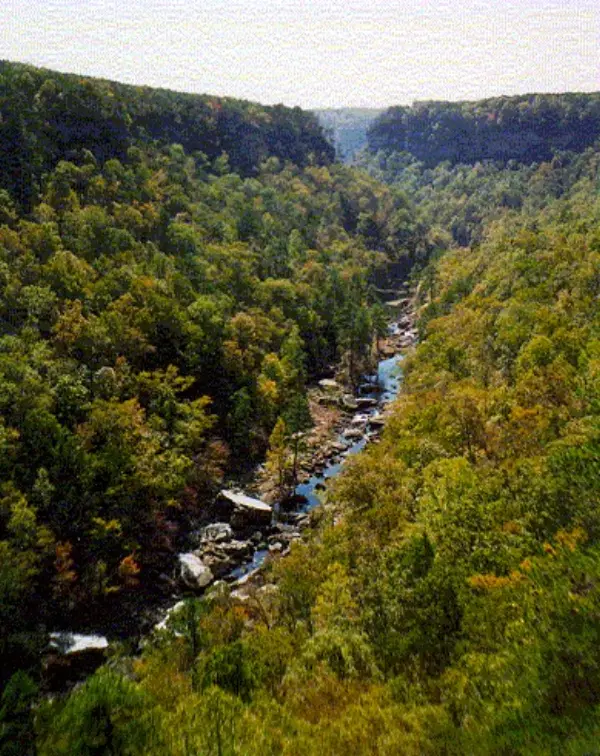
Perched atop Lookout Mountain in northeastern Alabama, the West Fork of the Little River carves its way through ancient sandstone and dense hardwood forest before plunging dramatically over DeSoto Falls.
Deep in the Bankhead National Forest of northwest Alabama, the Sipsey River carves its way through sandstone canyons and ancient hardwood forest, earning its place as Alabama's only designated Wild and Scenic River.
Turkey Creek Nature Preserve in Pinson, Alabama (north of Birmingham) is a free Forever Wild / Jefferson County Greenways preserve with Blue Hole and falls swimming along Turkey Creek. No lifeguards — pack out trash.
For thousands of years, and stepping into their currents, you feel the weight of that past in the most elemental way possible. This is central Alabama at its most honest and unhurried.
The swimmable water splits between the Appalachian foothills of north Alabama — Bankhead National Forest, Little River Canyon, and the sandstone gorges around DeSoto — and the slow blackwater creeks of the coastal plain.
Upland creeks run clear and cool over sandstone; southern creeks are tannin-stained but warm.
Reading conditions before you go
Flow makes or breaks a waterfall. Too little and it is a trickle over dry rock; too much and the plunge pool becomes a churning hydraulic you cannot swim out of. Late spring and early summer usually strike the balance.
Plunge pools are the coldest water in most watersheds. Falling water aerates and shades the pool, so expect it several degrees colder than the stream above it.
Check whether swimming is actually permitted. A high share of the most photographed waterfalls in the country carry enforced no-swimming orders after fatalities — Ricketts Glen, Hocking Hills, and much of the Catskills among them.
In Alabama, the Alabama Department of Environmental Management publishes the water-quality and algal-bloom advisories that apply to these waters. Check them alongside the live gauge data rather than instead of it.
Waterfall safety in Alabama
Wet rock above a drop is the single most dangerous surface in outdoor swimming. Falls, not drownings, cause most waterfall deaths, and the algae film on polished rock offers almost no friction even in good shoes.
The base of a falls can hold a recirculating current that pushes a swimmer down and back toward the curtain. Enter to the side of the flow, never directly under it.
Do not climb the falls to jump. Depth at the base changes with every flood, debris collects in the pool, and there is rarely a clean line back out.
Summer thunderstorms can raise canyon creeks fast — Little River Canyon in particular goes from ankle-deep to unswimmable within hours of upstream rain.
Cold water deserves more respect than most swimmers give it. The National Weather Service notes that cold shock can be as severe at 50-60°F as at 35°F, and that the involuntary gasp reflex can be triggered by water as warm as 77°F — which is why entering slowly matters even on a hot day.
When to go
Alabama swims may through september, with the most reliable water june to august. Late April and early October are swimmable in the southern half on warm afternoons; north Alabama creeks stay cold into May.
Waterfalls peak visually in spring runoff and peak for swimming in early to midsummer once flow eases.
6 of these listings carry their own best-time note from the land manager or from reader reports — open them for the specifics rather than relying on the state-wide window alone.
What to bring: Grippy footwear you are willing to swim in, and a helmet if your group scrambles near the lip.
How many waterfall swimming holes are there in Alabama?
We document 6 waterfall swimming holes in Alabama. That is the number with enough verified detail — access, directions, and conditions — to publish, not the total number that exist. They cluster near Birmingham, Anniston, Talladega, and Montgomery.
When is the best time to swim waterfall spots in Alabama?
May through September, with the best conditions june to august. Late April and early October are swimmable in the southern half on warm afternoons; north Alabama creeks stay cold into May. Waterfalls peak visually in spring runoff and peak for swimming in early to midsummer once flow eases.
Are Alabama waterfall swimming holes free?
Of the 6 listed here, 3 free, 1 fee or park admission, 2 varies. Fees are usually a state park or day-use charge rather than a swimming charge, and they change season to season — open the individual listing before you drive.
What should I check before swimming in Alabama?
Three things: the live flow or level at the nearest USGS gauge, the current advisories from the Alabama Department of Environmental Management, and the forecast for anywhere upstream of you. Summer thunderstorms can raise canyon creeks fast — Little River Canyon in particular goes from ankle-deep to unswimmable within hours of upstream rain.
Is it safe to swim in Alabama waterfall spots after rain?
Generally no, not straight away. Runoff raises the current, pushes new debris into familiar pools, and spikes bacteria counts. Give moving water 24 to 48 hours to clear after heavy rain. In narrow gorges the bigger risk is flash flooding — rain miles upstream under a clear sky above you is enough to raise the water fast.